Installation and live performance · 2026. Shown at Exposition de la Bléch, Lausanne, May 2026.
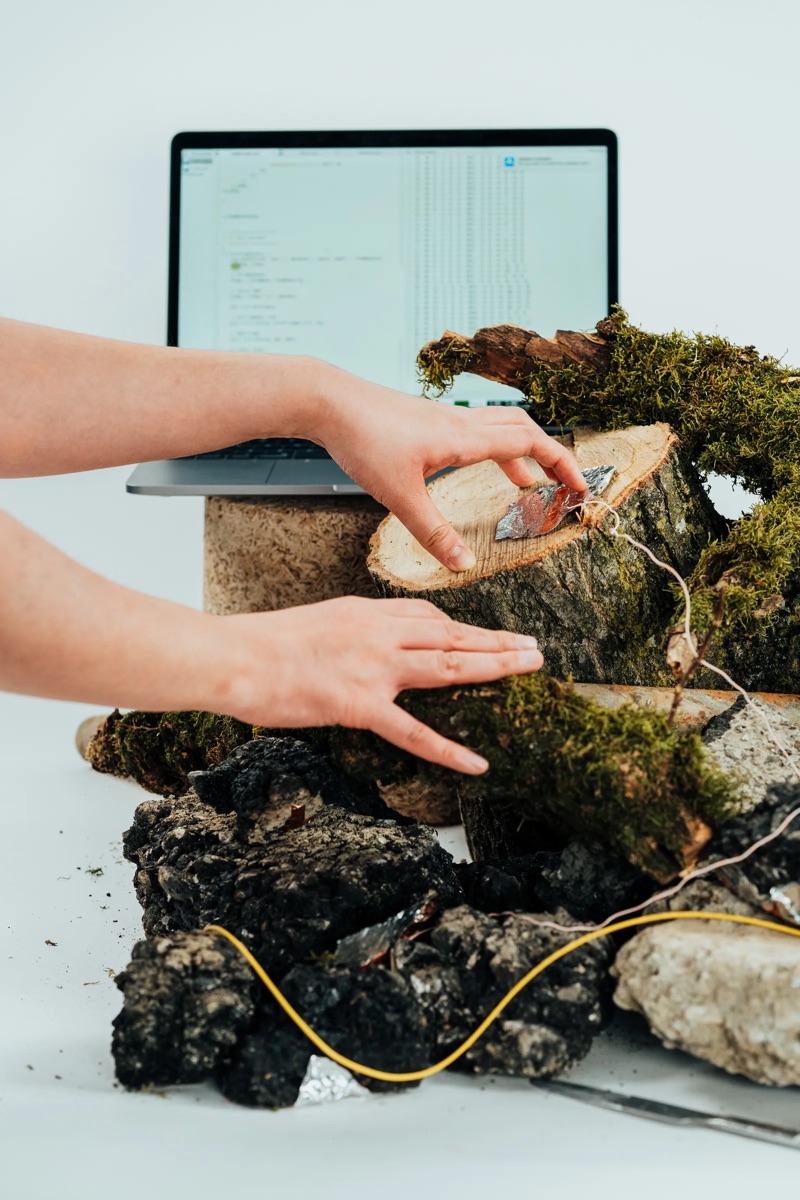
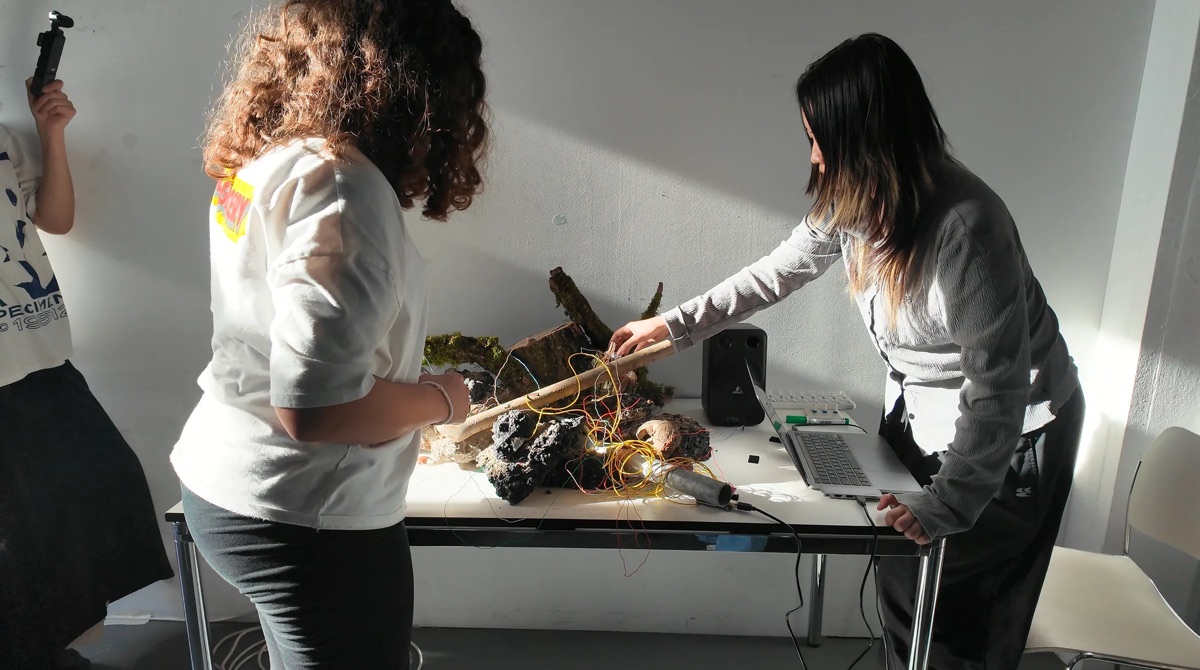
A participatory sound installation that is also a performance instrument. Living wood and industrial material are wired up as one controller: tree stumps, branches, moss and stones next to asphalt, cement and steel pipe.
- Touch a branch: the natural layer changes, and the birdsong grows louder.
- Touch a steel bar: the rhythm of the mechanical layer speeds up.
Natural elements give organic textures; industrial ones give mechanical, fragmented sound.
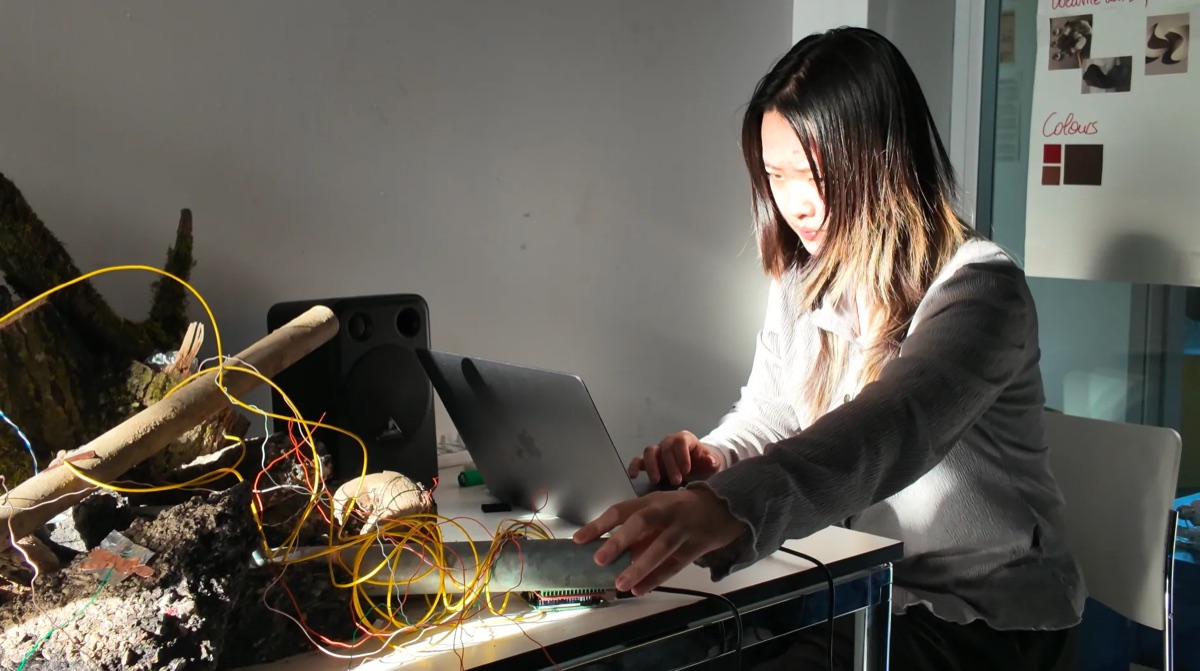
The touches arrive as unpredictable sensor data. I live-code in SuperCollider beside the installation and feed that data into a structure that is already running. So two parties play the piece at once: the visitors’ hands change the code, and their sounds only take shape by passing through it. There is no single point of control, and the setup is modular, so it can be rebuilt to fit the site.
How it is built
| Sensing | Capacitive touch and proximity, Arduino Uno |
| Sound | SuperCollider, played live; generative, nonlinear processes |
| Mapping | Sensor signals control oscillator frequency, filter cutoff and sample playback speed |
| Materials | Branches, tree stumps, stones, dust, asphalt, cement, steel pipes, speakers |
| Size | Variable, depending on the site |
Where it sits in the research
This is the last piece before the thesis prototype, and the thesis starts from it. Each visitor’s touch was connected to the system and to me, not to the other visitors standing there at the same time. The prototype, Interdependent Instrument, narrows to that missing relation: the one between the people present. The work’s themes, urbanisation and the erasure of natural landscape, are part of the practice described in Starting Point.
photos: Dorota Grajewska