Matuszewski, Schnell & Bevilacqua (2019), Interaction Topologies in Mobile-Based Situated Networked Music Systems, Wireless Communications and Mobile Computing · doi:10.1155/2019/9142490
Also: Weinberg (2005), Interconnected Musical Networks · Matuszewski (2020), A Web-Based Framework for Distributed Music System Research and Creation (soundworks)
The problem. Weinberg (2005) argued that the social organisation of a musical network is designed through its low-level topology. The authors point out that their own framework, soundworks, always runs through one central server. Read literally, that argument would mean every piece built on it is a star (Weinberg’s flower).
The proposal. Describe the possible interactions between entities, human and technical, separately from how information is physically transmitted, and with no prior hierarchy between them. There are six basic figures:
| Figure | Shape |
|---|---|
| (a) Disconnected graph | everyone acts alone |
| (b) Unidirectional circular graph | each passes to the next, one way |
| (c) Bidirectional circular graph | each exchanges with their neighbours |
| (d) Centrifugal star graph | one centre sends out to all |
| (e) Centripetal star graph | all send in to one centre |
| (f) Forest | separate small groups |
One system can be described from several points of view by combining figures, for example one figure for time and another for information flow. The paper shows each figure through a soundworks piece played on audience phones.
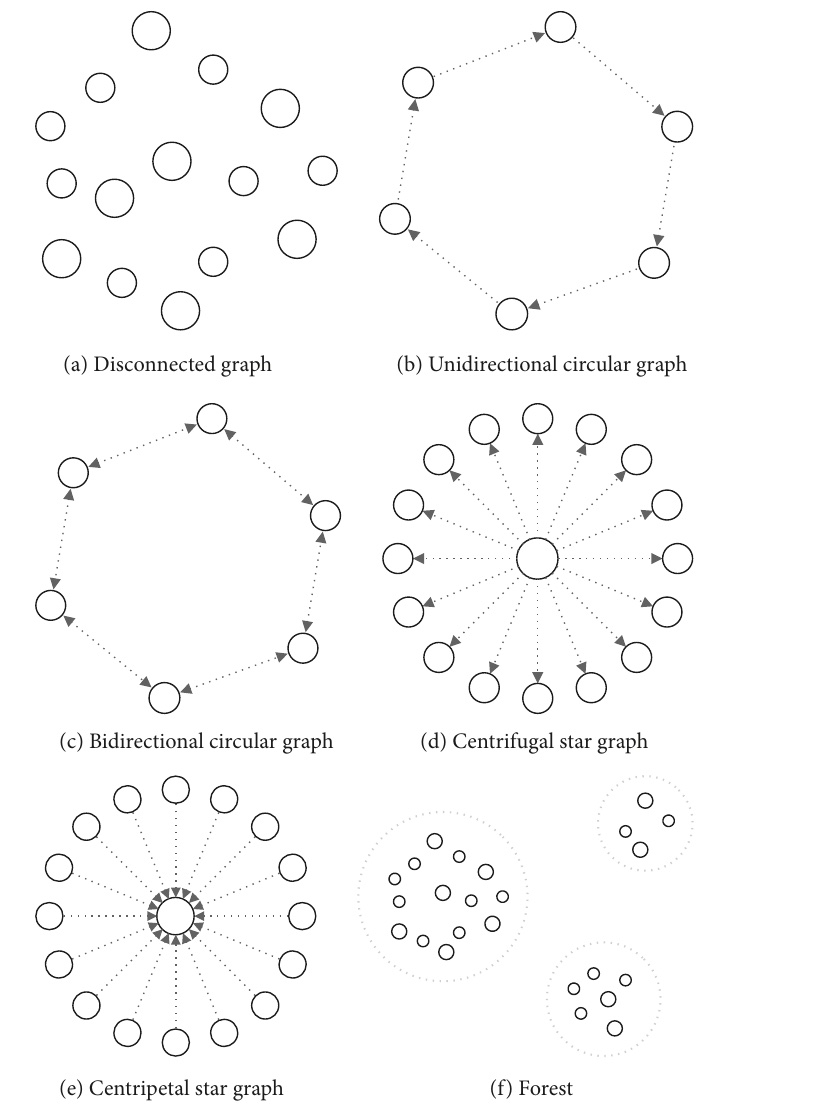
image: Matuszewski, Schnell & Bevilacqua 2019, fig. 3 (CC BY 4.0)
Used here as vocabulary for “who can change what of whom”. Simone is described in these terms, and the prototype, Interdependent Instrument, is built on soundworks.