Description
Aliénor Golvet, Benjamin Matuszewski, Frédéric Bevilacqua · IRCAM (STMS) · Audio Mostly 2024
Simone is a distributed instrument: a set of browsers on a local network that together make one system. Each player records a model sound into a microphone, often their voice, and picks a generator sound. Audio mosaicing rebuilds the model from small grains of the generator, so the result follows the shape of what you recorded with the timbre of something else.
Taking a cue from the network-music group The Hub, where the communication protocol was itself the composition, the instrument comes in three scenarios. Each opens a different channel between players:
- Drum Machine — everyone shares a clock from the server and loops lengths on a common rhythmic grid. Nothing else passes between players.
- Clone — before playing, each person’s recording is sent to another player, who must then play with it as their generator. The channel is open only before the performance.
- Solar System — asymmetric. One player, the Sun, records the model; its analysis streams live to every Satellite, who each re-voice it with their own generator.
Nine improvising musicians with electronic-music experience played in groups of three, 7–8 minutes per scenario, followed by group discussion and a semi-structured group interview. The authors report that appropriating the instrument depended on musical background and experience, and came before any collaboration.
Built on IRCAM’s soundworks framework for distributed web applications. The scenarios are described as different interaction topologies, a term from Matuszewski, Schnell & Bevilacqua (2019).
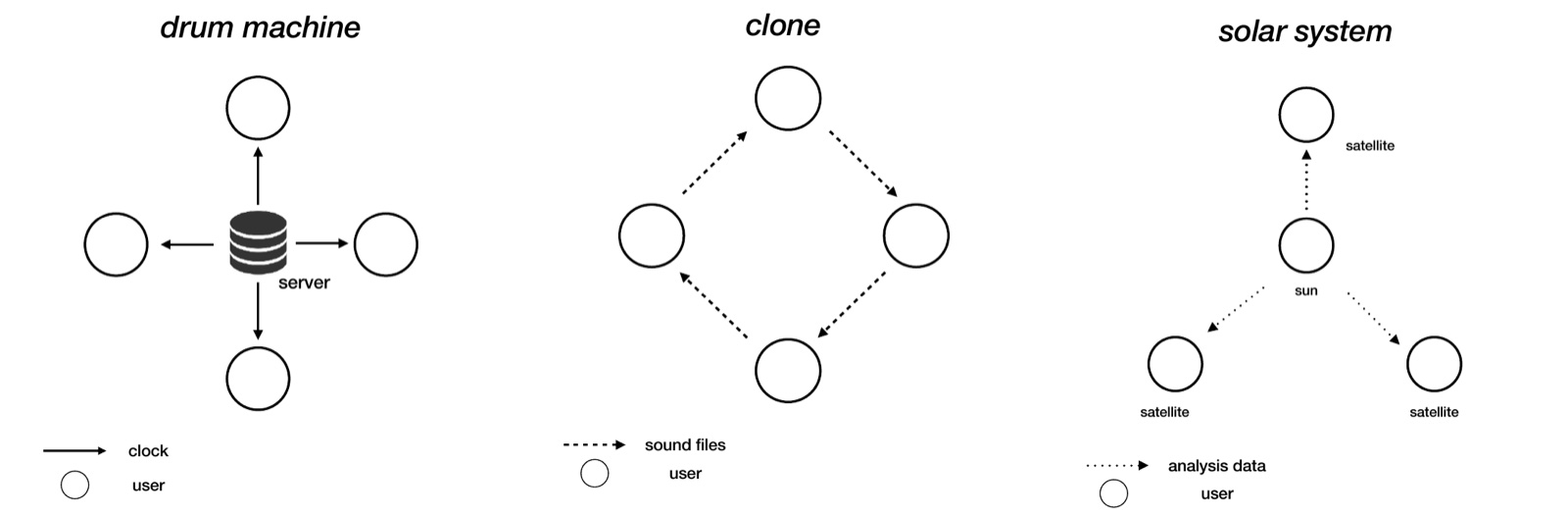
image: Golvet, Matuszewski & Bevilacqua, “Designing a distributed musical instrument for collective improvised interaction”, AM ‘24, figs. 2–4 (CC BY 4.0)