Hattwick & Wanderley (2012), A Dimension Space for Evaluating Collaborative Musical Performance Systems, NIME · doi:10.5281/zenodo.1178281
What it is. A dimension space for describing one configuration of a digital music ensemble, often specific to a single composition or installation. It is modelled on Birnbaum et al.’s dimension space for musical devices, and several axes are taken from Weinberg. Each axis is a pair of limits plus the questions that place a configuration on it:
| Axis | Limits | Asks |
|---|---|---|
| Texture | homogeneous / heterogeneous | How discernible are the individual parts? |
| Equality | equal / unequal | Is there a leader? Do players have access to the same data? |
| Centralization | centralized / decentralized | Is information shared through a central server? How important are global parameters such as tempo? |
| Physicality | fixed / free | Are players in the same space? How much do visual contact and entrainment matter? |
| Synchrony | synchronous / sequential | Is information shared in real time, or turn by turn? |
| Dependence | independent / interdependent | Can a performer make sound without input from the others? Do they share control of a musical event? |
The axes describe the character of a collaboration; they do not rank it. The authors offer two uses: evaluating existing configurations, and finding under-explored ones to design.
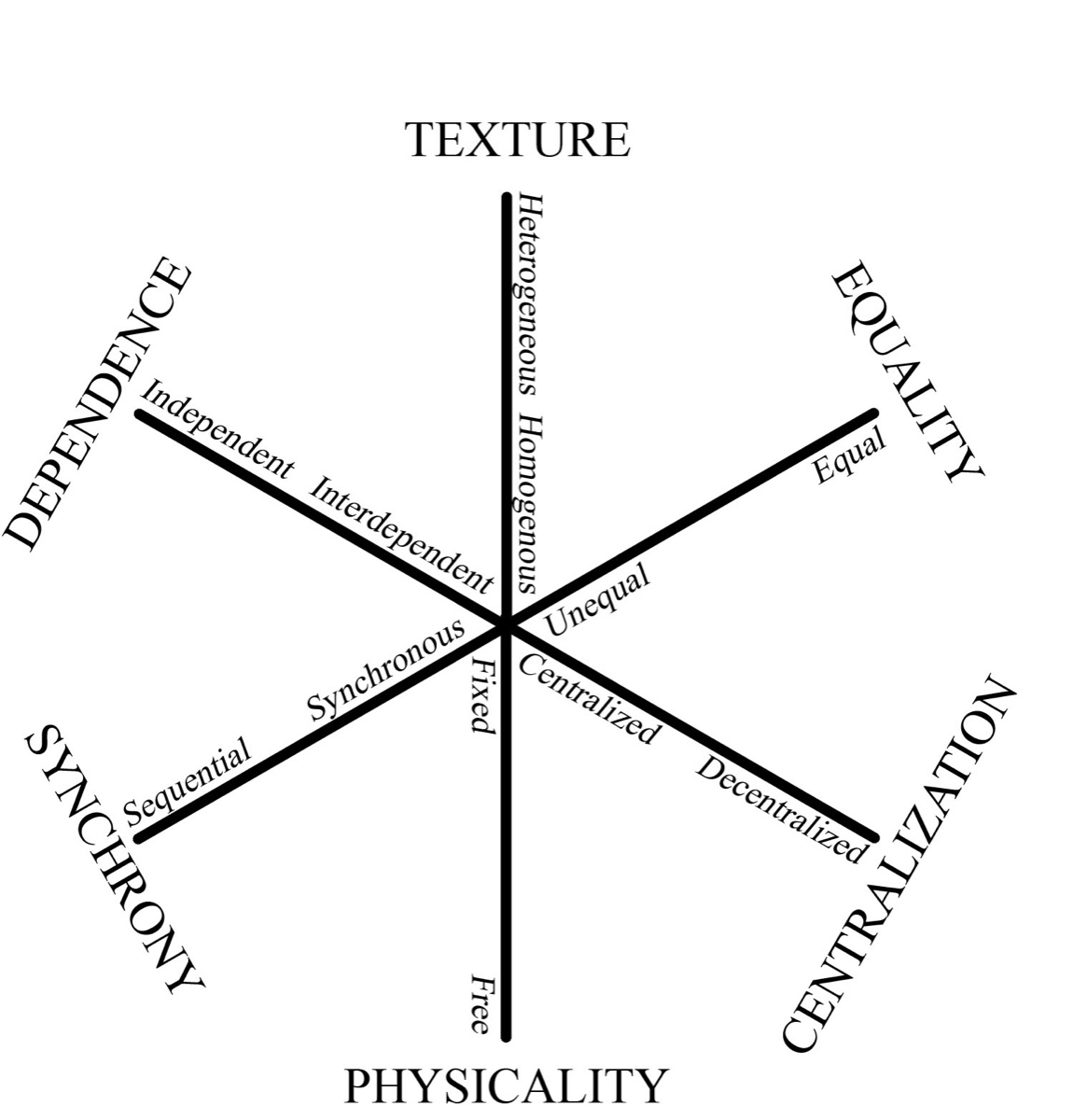
image: Hattwick & Wanderley, NIME 2012, fig. 1 (CC BY 4.0)
Used here as a source for the dependence dimension: whether a person’s sound depends on someone else’s input.