Description
Sidney Fels, Linda Kaastra, Sachiyo Takahashi, Graeme McCaig · University of British Columbia · NIME 2004
Tooka is a flexible tube, 86 cm long, with a mouthpiece at each end and an air-pressure sensor in the middle. Two players seal opposite ends with their mouths and share one closed column of air: “The players collectively modulate the tube pressure to control sound.” Breath pressure maps to volume. Pitch comes from buttons — each player has two black note buttons, and the four together select from sixteen pitches, while each player’s white button shifts the octave. Melodies therefore need coordinated presses from both sides. A bend sensor lets the pair bend the tube together for pitch bend, and thumb sensors add vibrato.
The 2004 version adds a red capture/sustain button that holds the sounding note as a drone. One player cannot capture twice in a row — “Coordinated turn-taking is required to build layers of notes” — and whoever pressed last controls the whole stored buffer. The authors note that this is hard to learn, because “it is easy to lose track of whose turn it is”, and that it deliberately goes against usual HCI guidelines to require more communication between the players.
The design evolved from the experience of two trained musicians, a bassoonist and a Noh flute and recorder player, who practised with it for fifteen hours and made recommendations along the way.
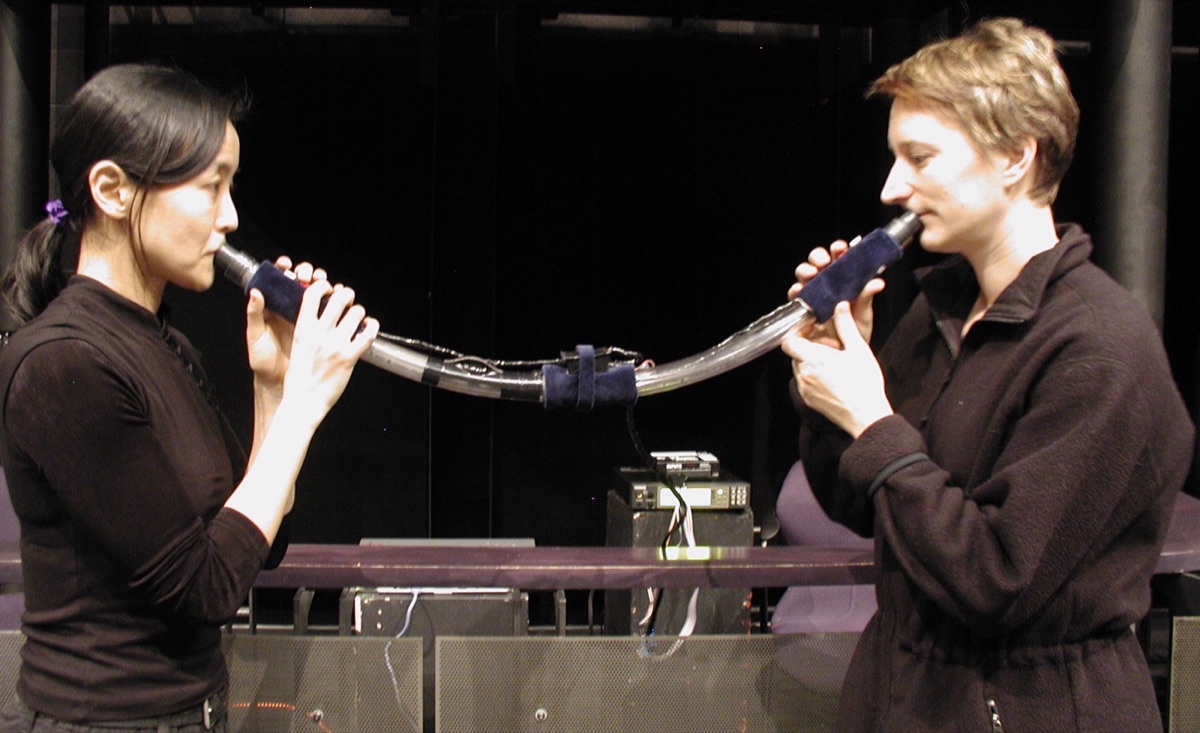
image: Fels, Kaastra, Takahashi & McCaig, “Evolving Tooka: from Experiment to Instrument”, NIME 2004 (CC BY 4.0)