Description
Derrick M. Wang, Sebastian Cmentowski, Reza Hadi Mogavi, Kaushall Senthil Nathan, Eugene Kukshinov, Joseph Tu, Lennart E. Nacke · University of Waterloo · CHI 2025
A co-located exergame built in Unity for the ExerCube, a mixed-reality booth with three cushioned projection walls. Two players wear trackers on both wrists and catch glowing orbs that appear on the walls — stepping, reaching, now and then jumping or crouching. A voice-acted tutorial frames each round as a different “job” on a space-scavenging mission.
The setting stays the same across rounds; only the rule binding the two players changes:
- Free — both players chase the same orbs; cooperation is optional. The baseline.
- Coupled — each player catches only orbs of their own colour, and both feed one shared score, so the two have to negotiate the space between them.
- Concurrent — an orb only counts if both players hit it at the same time. The time limit is stretched from 3 to 4.5 seconds to keep difficulty comparable.
Twenty-four participants in twelve pairs played all three in counterbalanced order, three minutes each. The study combined questionnaires on enjoyment, motivation, relatedness and team identification with heart rate, in-game performance and interviews. The authors report that the cooperative conditions improved relatedness and team identification over the baseline.
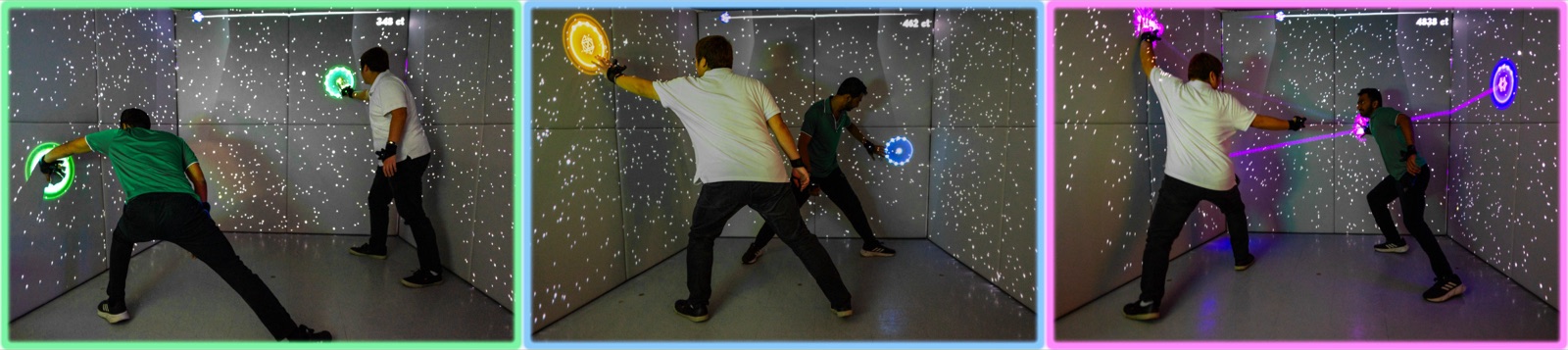
image: Wang et al., “From Solo to Social”, CHI 2025, fig. 1 — free, coupled, concurrent