Description
Steve Symons · University of Sussex · AI Music Creativity (AIMC) 2023
Two players stand side by side, each with a hand tethered to a GameTrak controller — two joysticks on retractable nylon cords that track hand position in about a cubic metre of space. The Causilo is one of several “entangled” instruments in a practice-research project that couples players’ actions so that neither plays a separate part.
Its engine runs a Granger causality test on the two movement streams, live: is player A’s recent movement a predictor of player B’s, and the other way round? The two results are averaged and mapped to a single oscillator and filter. Symons is explicit that this is a deliberate mis-application of a statistical tool — “moving from ‘trying to measure’ to ‘trying to influence’ player interaction”. Moving at the same steady speed close together is the way to steer it.
Four pairs played it for up to ten minutes and were interviewed. They described it less as an instrument than as something with a will of its own:
A5: no no its not an instrument
A7: an organism
Other comments ran from “you were needing to co-ordinate rather than react” to feeling “at the mercy of” the system. The paper sets it beside the Elastiphone, a more directly reactive instrument built on a virtual elastic band between the two players’ hands, using the same synthesis engine.
An earlier instrument in the same project, on granular synthesis, is where the observation started: one player would stop and let the other explore, and in interview the two disagreed about who had been leading.
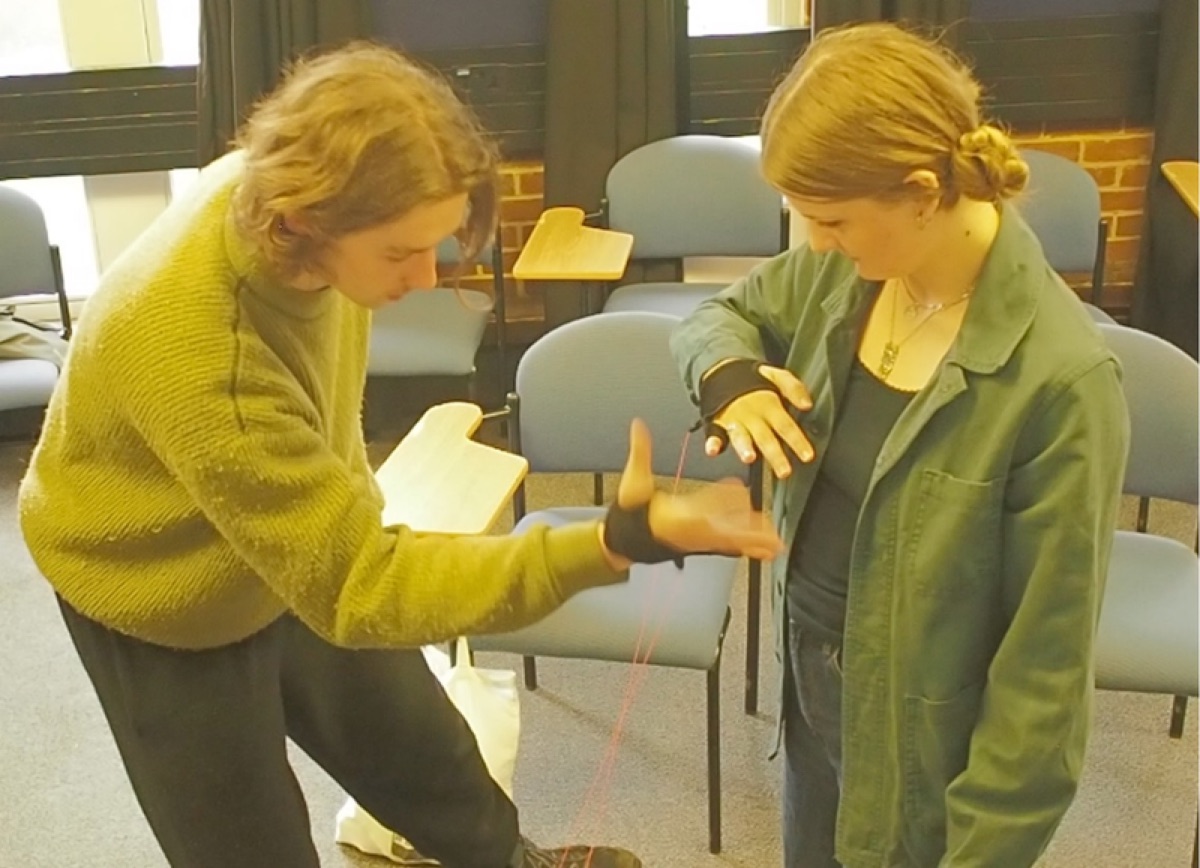
image: Symons, “Introducing the Causilo”, AIMC 2023, fig. 1 — the earlier granular-synthesis instrument with the same GameTrak setup (CC BY 4.0)